Worship in Spokane Valley
Join us for Sunday Divine Liturgy at 2:30 pm at St. Mary Catholic Church while our parish awaits its new home.
St. Mary Catholic Church, 304 S Adams Road, Spokane Valley, WA 99216
Weekly liturgical schedule
Unless otherwise noted, services and sacraments are held at St. Mary Catholic Church.
Divine Liturgy
- Sunday
- 2:30 pm
- Wednesday
- 9:00 am
- Thursday
- 10:00 am
Confession
- Wednesday
- 8:30 am
- Friday
- 6:00 pm or by appointment
- First Sunday of the month
- 1:30 to 2:00 pm
Our first Divine Liturgy at St. Mary’s was scheduled for May 24. We are grateful to the priest, staff, and parishioners of St. Mary’s for the use of their facilities. Please keep them in your prayers.
Our outreach communities
Montana
Divine Liturgy is at 6:00 pm on the third Sunday of the month at Christ Mission, 5475 Farm Road, Lolo, Montana. The community also meets at 5:30 pm on the Saturday before that Sunday. You are welcome to join us on Saturday as well.
Tri-Cities, Washington
Divine Liturgy is at 9:00 am on the second and fourth Sundays of the month at the small church of St. Joseph Catholic Church, 520 S Garfield St, Kennewick, WA 99336. Visit the Tri-Cities outreach for the current schedule.
Lewis-Clark Valley Byzantine Catholic prayer group
Pray with us and join us for potluck fellowship on Saturdays from 5:00 to 6:00 pm. The group offers Catechesis of the Good Shepherd for children. Find the Lewis-Clark Valley prayer group on Facebook.
About our parish
We are a Byzantine Catholic parish in Spokane Valley, Washington. Our parish serves Byzantine Catholics in eastern Washington, northern Idaho, and Montana. We follow the traditions of the Ruthenian Byzantine Catholic Church, worship according to the ancient liturgical practices of Constantinople, and celebrate the heritage and customs of the Slavonic peoples of Eastern Europe.
As Byzantine Catholics we belong to one of the autonomous Eastern Catholic Churches in full communion with the Pope of Rome. We welcome guests, Orthodox Christians, and Catholics from other rites to worship Christ Jesus our Lord with us.
Our clergy
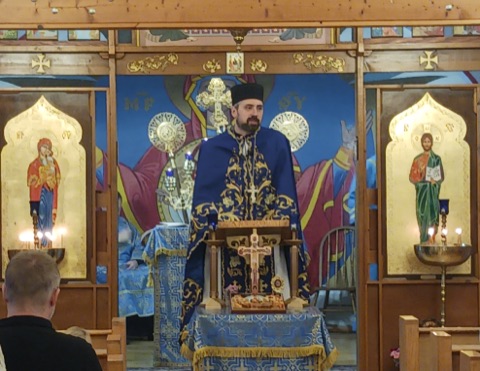
Father Benjamin Crow began serving our parish on August 1, 2025. He is always happy to answer questions and speak with guests and members of our community.
Deacon Tony Holt also serves our community. He comes to us from North Dakota.
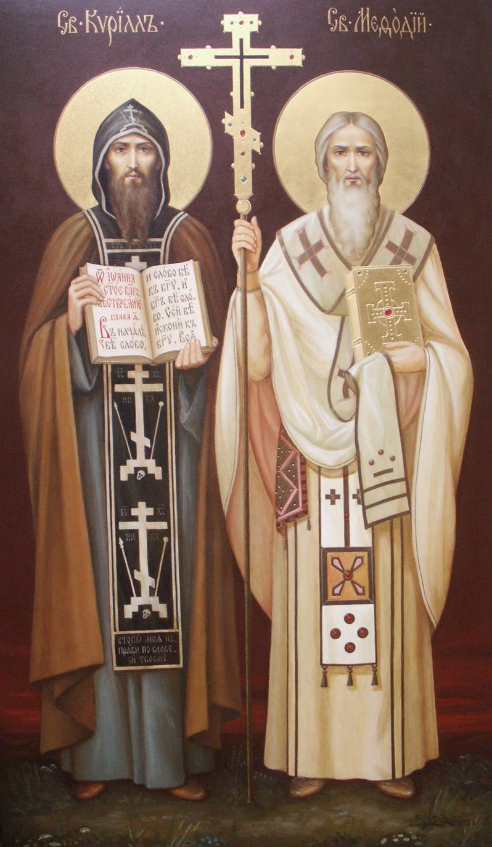
Who were Saints Cyril and Methodius?
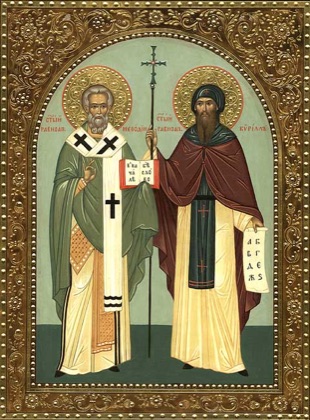
Saints Cyril (825-69) and Methodius (826-84) were brothers born in Thessalonica, Greece. Cyril was sent to study in Constantinople at an early age. After being ordained he held a position at the university. Methodius became governor of one of the Slav colonies in Opsikion Province and then later became a monk.
In 861, Emperor Michael III sent both brothers, who had been living in a monastery, to Russia to convert the Khazars. After learning the Khazar language they converted many people.
On their return in 863, they were sent to convert the Moravians. They were extremely successful because of their knowledge of the Slavonic language. They invented an alphabet named Glagolithic, which was the beginning of Slavonic literature, and translated liturgical books into Slavonic. Their missionary work was hampered by the German clergy and the German bishop of Passau who did not like their use of Slavonic in church services, did not like that they were from Constantinople, and refused to ordain their candidates for priesthood. Pope Nicholas I asked them to return to Rome, but while they were traveling he passed away. They were greeted instead by Pope Adrian II who received them warmly, approved the use of the Slavonic language in the liturgy, and announced that they were to be ordained bishops.
Shortly after their return to Rome on February 14, Cyril died. Methodius returned to Moravia a bishop. At the request of the Princes of Moravia and Pannonia, the Pope formed the archdiocese of Moravia and Pannonia, independent of the German hierarchy, and made Methodius archbishop at Velehrad, Czechoslovakia.
In 870, the German King Louis and the German bishops imprisoned Methodius for two years until he was released by order of Pope John VIII and forbidden to use Slavonic in the liturgy. He was summoned to Rome in 878 for using Slavonic in the liturgy. Pope John VIII was impressed by Methodius's arguments that he again permitted the use of Slavonic in the liturgy.
Methodius traveled to Constantinople to finish the translation of Scriptures that he had begun with his brother Cyril. Throughout the remainder of his life he continued to struggle with the Germans. He passed away on April 6. Cyril and Methodius are called "Apostles of the Slavs."
The Universal Church Feast Day was established as February 14 by Pope Leo XIII in 1880. The Eastern Church remembers and honors St. Cyril on February 14, St. Methodius on April 6, and both SS. Cyril and Methodius on May 11.
Come visit us
We have found the True Faith, and we worship the Undivided Trinity, who has saved us.